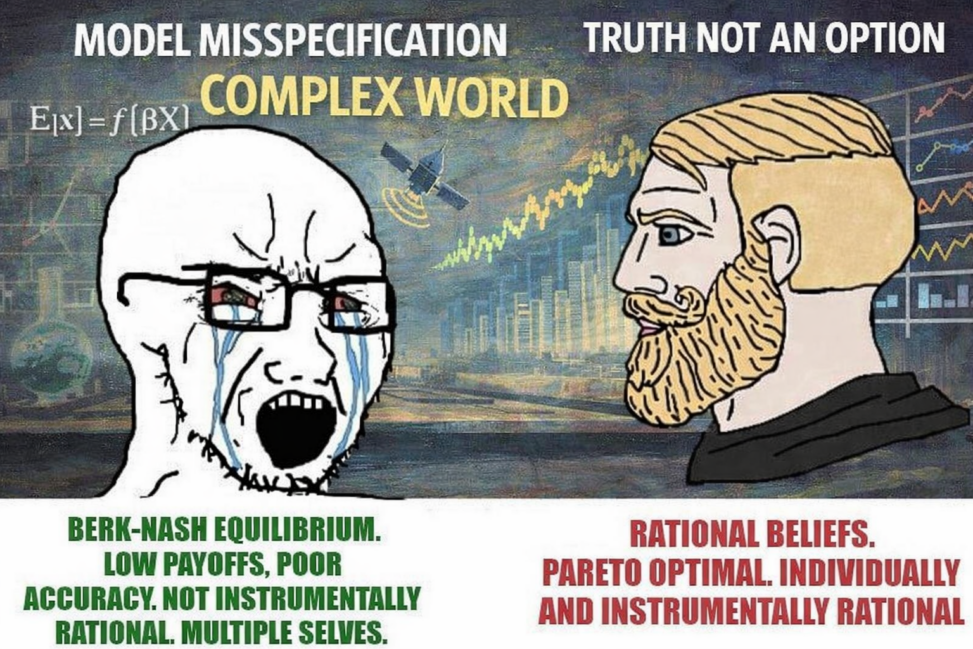
In misspecified environments, should an economic agent act rationally towards optimizing some goal? If so, what should that goal be? Recent work has focused on the goal of bidirectional consistency of beliefs and actions, in effect finding a Nash equilibrium of an imaginary game in which one player chooses actions and another player chooses beliefs. In general, such outcomes, known as Berk-Nash equilibria, maximize neither log-likelihood nor objective payoffs over the combined space of beliefs and actions. We suggest an alternative: a solution concept and associated learning algorithm by which economic agents maximize a goal function that is a convex combination of log-likelihood (accuracy) and objective payoffs. This selects models that are Pareto efficient and favored by evolutionary forces. That is, in a society of individuals following different models, if models leading to high payoffs and accuracy replicate themselves or are imitated more than less successful models, then society evolves towards maximizing our goal function. One implication is that individuals who play Berk-Nash equilibrium in such societies will go extinct unless they happen to be successful in terms of our goal function.
Coauthored with Filippo Massari.
Published in International Journal of Game Theory (2026). Link to paper.
The thumbnail image is of a decision maker that follows Berk-Nash equilibrium being comprehensively outperformed by a decision maker with rational beliefs.